Rise & Shine
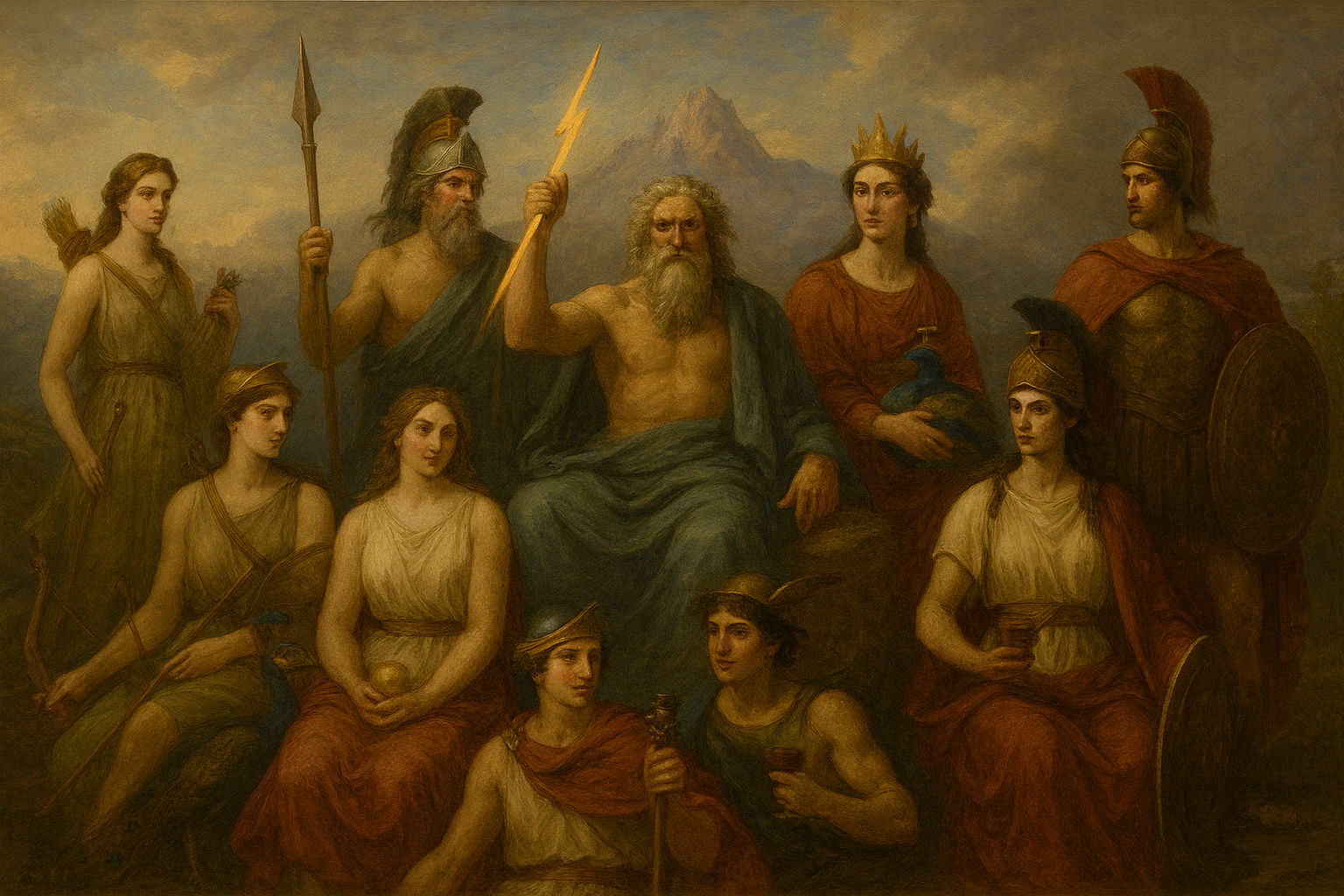
⚡The Pantheon of Olympus ⚡
⚡⚡⚡⚡⚡⚡⚡⚡⚡⚡⚡⚡

"Where thunder meets the sea, and fate dances upon the loom of time."
1. Zeus — King of the Gods
Zeus commands the heavens, his lightning bolts striking with divine precision.
The air trembles when he speaks.
No oath escapes the ear of Zeus.
His will shapes the destiny of mortals.
His throne gleams in gold and stormlight.
Learn more: Mount Olympus

2. Hera — Queen of the Heavens
Hera, goddess of marriage and guardian of vows, holds a regal yet unyielding heart.
She wears a crown of peacocks, symbolizing watchfulness and pride.
Her voice is calm, yet every word carries the weight of eternity.
“Even gods must answer to justice, for I am the balance of Olympus.”

3. Poseidon — Lord of the Seas
🌊 Poseidon rules with a trident that splits the oceans.
Italicized list example:
Waves that obey his mood
Storms that mirror his rage
Creatures that whisper his name
Numbered list:
Command of tides
Creation of horses
Builder of Atlantis
Nested list:
Domain
Oceans
Earthquakes
Floods

4. Athena — Goddess of Wisdom and War
Attribute | Symbol | Domain |
|---|---|---|
Wisdom | 🦉 | Knowledge & Strategy |
War | ⚔️ | Tactical Brilliance |
Crafts | 🏺 | Civilization & Art |
In the mind of Athena, strategy is like code:
if (wisdom > pride) { victory = true;} else { downfall = inevitable;}
5. Apollo — The Radiant Archer
He strums the lyre of logic and light.Apollo symbolizes balance, healing, and music.
“Where knowledge and beauty converge, I am the song.”
6. Artemis — The Huntress
Artemis roams the night with silver bow in hand.
Her followers whisper among the trees:
The moon is her mirror, the forest her temple.
“Freedom is sacred — guard it as fiercely as you breathe.”
7. Hades — Lord of the Underworld
Deep beneath the earth, shadows stir.
Hades sits upon a throne carved of obsidian and memory.
His realm is one of order, not cruelty — a place where the living find truth in silence.
Here, all souls are equal.
8. Aphrodite — Goddess of Love
💗 Aphrodite, born from seafoam, walks where desire takes form.
Her laughter is light, her touch eternal.
Even the gods cannot resist beauty.
Checklist Example:
Charm
Grace
Power to inspire
9. Ares — God of War
🔥 The battlefield trembles at his roar.
War is chaos. War is creation. War is the pulse of gods.
Ares teaches that violence and valor are two faces of the same coin.
He is both savage and sacred, the embodiment of raw passion.
10. Hestia — Keeper of the Hearth
Her flame never dies.
🏠 The hearth is home — even for gods. 🕯️
She reminds all beings that peace begins in the warmth of kindness.
Under her gaze, Olympus finds its calm.
11. Hermes — The Messenger
✉️ The fleet-footed trickster dances between realms.
Always moving, never caught.
“Every boundary is a door if you know how to knock.”
speed = wit + wings
12. Dionysus — God of Revelry
🍷 Chaos and joy entwine in his laughter.
He turns pain into poetry, order into ecstasy.
Madness is divine when it opens the mind.
And in the dance, all mortals remember they were once stars.
Zeus
Zeus, the mighty ruler of Olympus, was not merely a god of thunder — he was the embodiment of divine authority, the force that held heaven and earth in balance. Born of the Titan Cronus and Rhea, his life began in secrecy, hidden away in a cave on Mount Ida while his father devoured his siblings out of fear of prophecy. When Zeus grew to manhood, his power surged like the first rumble of a coming storm. With cunning and courage, he forced Cronus to disgorge his brothers and sisters, and together they waged the great Titanomachy — a war that reshaped the cosmos. Lightning became his weapon, the sky his throne. Mortals trembled at his storms, yet prayed to him for rain to nourish their crops. To the gods, he was both father and judge, his word law, his will unchallenged. But beneath the majesty of his thunderous rule lay a complexity unmatched by any other deity — a being capable of mercy and wrath, wisdom and desire. His love affairs, countless as the stars, birthed heroes and demigods whose tales echoed through ages. Still, even in passion, his eyes were always on the horizon, scanning for defiance, for he knew that every crown — even one forged in lightning — must be defended by fire. To mortals, Zeus was the keeper of justice; to gods, the arbiter of fate; and to the universe itself, the heartbeat of order within chaos.
Hera
Hera, Queen of the Heavens, was a goddess born of both grace and storm — a being whose beauty veiled the weight of divine judgment. The daughter of the Titans Cronus and Rhea, she was swallowed at birth like her siblings, hidden in the darkness of her father’s fear until Zeus, her youngest brother, overthrew the tyrant and set them free. When she emerged from that long night, she carried within her a serenity that few could match, yet beneath it burned the fire of one who had seen the world’s first chaos. From the moment Zeus laid eyes upon her, he was captivated — for even the Lord of Thunder could not resist the calm strength in her gaze. Though his courtship was relentless, Hera resisted his charm, knowing that power often masked impermanence. It was said that Zeus transformed into a trembling cuckoo to seek her compassion, and when she drew the bird close to her breast, he revealed himself and won her heart. Their wedding, celebrated at the peak of Mount Olympus, crowned Hera as the eternal Queen, her crown of gold gleaming brighter than lightning itself.
But Hera was not content to be merely consort. She was a ruler in her own right — the protector of marriage, the guardian of vows, and the embodiment of sacred unity. To mortals, she was the divine matron who blessed the faithful and punished the faithless; to the gods, she was both feared and revered. Yet her love for Zeus, as boundless as it was, became her greatest torment. For Zeus, ever unrestrained, scattered his affections among goddesses, nymphs, and mortal women alike. Hera’s heart, though strong as diamond, knew jealousy’s sting all too well. The myths remember her wrath — the serpent she sent to haunt Leto, the endless trials of Heracles, the storms that pursued Io. But behind every tale of vengeance lay the cry of a queen betrayed — not by power, but by love unkept.
Still, Hera’s wisdom was unmatched. When Olympus quarreled, it was her voice that restored order; when mortals faltered, it was her justice that held them accountable. Her peacocks, with eyes like stars, followed her through the skies, symbols of vision and eternity. In the great halls of Olympus, she sat upon a throne carved from ivory and gold, her scepter tipped with the lotus of life — a reminder that creation and destruction often share the same root. Beneath her regal calm lay the pulse of compassion: for every punishment she delivered, there was a lesson woven in divine purpose. She was not cruelty, but consequence — not anger, but the echo of divine balance.
Poseidon
Poseidon, the Lord of the Seas, was not just the god of oceans — he was the pulse of the earth itself, the restless tide that shaped both creation and destruction. Born of Cronus and Rhea, brother to Zeus and Hades, Poseidon rose from the chaos of the Titan wars with thunder in his veins and salt on his skin. When the world was divided among the three brothers, Zeus claimed the sky, Hades took the underworld, and Poseidon received the endless expanse of the sea — a kingdom untamed, ever shifting, and deep with mystery. With a strike of his trident, he could calm or shatter the waters, summon earthquakes, and raise islands from the abyss. Mortals both feared and revered him, for his mood changed with the wind: one day the ocean would cradle their ships in gentle waves, and the next it would swallow them whole.
In his palace beneath the sea, crafted from coral and pearls, Poseidon ruled over nymphs, sea spirits, and creatures that mortals only dared to imagine. Dolphins sang his praises, and hippocampi drew his chariot across the rolling surf. Yet his power extended far beyond the waves — when his temper flared, the very earth trembled, giving rise to his title as the “Earth-Shaker.” Proud and ambitious, he once contended with Athena for the city of Athens, striking the Acropolis with his trident to gift the people a spring of saltwater. But wisdom triumphed over might, and Athena’s olive tree won their favor. Though defeated, Poseidon’s pride endured; he respected the goddess’s cunning, for even gods could not always command the hearts of mortals.
Despite his storms, Poseidon was not without compassion. Sailors prayed to him for safe passage, and he often listened, granting calm seas to those who honored him. His love affairs were as vast as his domain — from the gentle sea nymph Amphitrite, his queen, to countless mortal women who bore him demigods and heroes. Among his children were the mighty Theseus and the fierce Polyphemus, beings as unpredictable as the tides themselves. Poseidon’s essence was balance: the calm before the storm, the power that both gives and takes life. To anger him was to invite ruin; to honor him was to ensure harmony between man and sea.
As ages passed and sailors ventured across uncharted waters, they whispered his name to the depths — a prayer, a plea, and a promise. Even now, when waves crash upon distant shores and thunder rolls across the horizon, it is said that Poseidon’s spirit stirs, reminding the world that no empire, no ship, and no soul can escape the will of the sea. For the ocean is his breath, the storm his heart, and every ripple upon the water carries the echo of the god who reigns beneath.
Attachments (5)
+5
More

Recent messages from